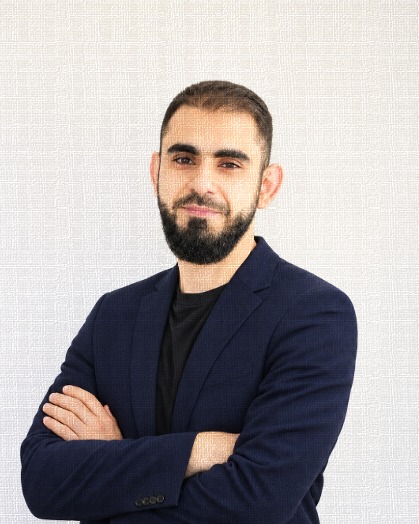
Ghaiath Almustafa

PhD · University of Technology Sydney

Ghaiath Almustafa

Green chemistry and machine learning for water and resource recovery.

A water & Env. engineer working where water treatment, green chemistry and machine learning meet, to recover lithium and other critical resources from brines.

Sydney, Australia · 33.87° S, 151.21° E

Portrait of Ghaiath Almustafa

Aqueous phase · brine

  • Li⁺
  • Na⁺
  • K⁺
  • Mg²⁺
  • B(OH)₃

Recovery of value-added minerals and strategic resources from aqueous streams. Selective hydrophobic compounds pull Li⁺, or boron, across the interface while Na⁺, K⁺ and Mg²⁺ stay in the brine. Designing that selectivity is my research. Move your cursor through the brine to stir it.

About

Now
PhD candidate, University of Technology Sydney
Group
Resource Recovery, Prof. Ho Kyong Shon
Before
R&D Engineer, DEWA R&D Centre, Dubai
Based in
Sydney, Australia
Questions I’m working on:
  1. Can machine learning predict which green solvents will work before we test them in the lab?
  2. How do we take selective lithium recovery from the lab bench to a process that scales?
  3. What cost do we pay from our waters to harvest minerals minerals and othe rstrategic resources?

Ghaiath Almustafa is a PhD researcher at the University of Technology Sydney (UTS). He joined Prof. Ho Kyong Shon's Resource Recovery group in 2024, working at the intersection of separation chemistry, materials science and machine learning. His research develops new classes of designer solvents and adsorbent for selectively recovering lithium from natural brines and spent battery leachates. Almustafa’s research is characterized by a strong integration of experimental design and computational screening, enabling the rational selection of solvent systems for high-efficiency separations. Through this work, he aims to bridge fundamental chemistry with scalable engineering solutions, helping to redefine how materials are recovered and reused in a resource-constrained world.

Previously, Ghaiath was working as engineer at the R&D Centre of Dubai Electricity & Water Authority (DEWA), where he was in charge of testing plot-scale water treatment units for local deployment and he helped design the new laboratories for the Water research group. He contributed to multiple invention disclosures, one of which was patented in the UAE. In 2025, he received a UTS Students as Partners project grant, through which he delivered modular workshops and seminars sharing practical research skills with fellow students.

Where my work sits

My work is at the intersection of three fields: water treatment, green chemistry, and machine learning.

Water & desalination

Since 2016

Water treatment and desalination, from policy to pilot units.

  • Lab- and pilot-scale desalination testing
  • Membrane distillation and brine management
  • Supported liquid and functionalised membranes
  • Water reuse policy and runoff modelling

Green chemistry & separations

Since 2018

Designing solvents and sorbents that pick one ion out of a crowded brine.

  • Hydrophobic deep eutectic solvents and ionic liquids
  • Selective lithium and boron extraction
  • Eutectogels
  • Solvent extraction and coordination chemistry

Machine learning

Since 2021

Letting data decide which chemistries are worth making.

  • Linking material properties to extraction performance
  • Data-driven materials discovery
  • ML-guided solvent screening pipelines
  • Molecular-based neural networks
Selected works

The path so far

From water policy in Sharjah to lithium recovery in Sydney, with pilot-scale R&D at a utility in between.

Hover over or tap a year to open that period.

  1. 2013 – 2017 · Sharjah, UAE

    University of Sharjah

    BSc student, then research assistant

    • BSc in Civil and Environmental Engineering, GPA 3.8/4.0.
    • President of the ASCE Student Chapter.
    • Research assistant from 2016: greywater reuse policy and reuse systems with the Sharjah Electricity & Water Authority (SEWA).
    • First start-up, WaterPalm: a modular, solar-powered atmospheric water generation device. Competed in the MIT Enterprise Forum (MIT-EF) Pan Arab competition 2017, was shortlisted regionally out of 9,000 applicants, and reached the semi-finals in Bahrain.
    • Judge on the panel of the Environmental Impact Assessment competition “The Great Debate”, University of Sharjah.
  2. 2018 – 2020 · Abu Dhabi, UAE

    Masdar Institute, Khalifa University

    MSc, research & teaching assistant

    • MSc in Water & Environmental Engineering, GPA 3.96/4.0. Thesis on green solvents for boron removal in water and wastewater treatment, supervised by Prof. Inas Al-Nashef and Prof. Hassan Arafat.
    • Young Future Energy Leaders (YFEL): graduate of Masdar’s programme.
    • Graduate teaching assistant, grading, auditing and proctoring courses.
    • Event organiser, Postgraduate Students Council, Khalifa University (Masdar campus).
  3. 2020 – 2022 · Abu Dhabi, UAE

    Center for Membranes & Advanced Water Technology (CMAT), Khalifa University

    Research engineer

    • Multidisciplinary research with Prof. Inas Al-Nashef and Prof. Hassan Arafat on eutectic solvents for boron and contaminant extraction.
    • Set up CMAT’s new laboratories during the 2020 pandemic, and designed and built new experimental rigs.
    • Funding proposals: helped write proposals to external funders, including the Abu Dhabi Department of Education and Knowledge (ADEK).
    • Lab operations: ran instrument training for lab users, kept the instruments maintained and managed the lab day to day.
  4. 2022 – 2024 · Dubai, UAE

    DEWA R&D Centre INDUSTRY

    R&D engineer

    • Pilot testing: tested a range of lab- and pilot-scale water treatment units for local deployment.
    • Designed new laboratories for the Water department.
    • Drafted invention disclosures, research proposals and technical reports.
    • Granted UAE patent: “Design for Continuous Operation of Multimedia Filter with Zonal Segmentation”.
    • Workshops on advanced skills for researchers.
  5. 2024 – 2027 · Sydney, Australia

    University of Technology Sydney

    PhD candidate, Resource Recovery group

    • Topic: selective lithium recovery from natural brines and spent-battery leachates, using designer solvents (hydrophobic deep eutectic solvents) and eutectogel sorbents.
    • Supervisor: Prof. Ho Kyong Shon.
    • Grant: UTS Students as Partners (2025), “How to present and represent”, with staff partner Dr. Sarah K. Miller: modular workshops and seminars on practical research skills for fellow students.
    • Tools developed: machine-learning models that link material properties from the literature to lithium extraction performance, part of the group’s discovery engine for screening solvent compositions.

Selected publications

Four of twelve journal articles, picked to cover water, solvents and machine learning.

Progress in Materials Science · 2025First author

Roadmap for integrating deep eutectic solvents into adsorption processes: a critical review & design blueprint

How eutectic solvents can be built into adsorption processes, reviewed and turned into a design blueprint.

G. Almustafa, R. Abu Alwan, H.K. Shon, J. Rodríguez, I. AlNashef

Read the paper ↗
Chemical Engineering Journal · 2024

Synergistic ternary deep eutectic solvents: an archetype for sustainable and eco-conscious Li and Co recovery from spent batteries

A glycine, ascorbic acid and water solvent that recovers lithium and cobalt from spent batteries.

H.K. Amusa, T. Lemaoui, G. Almustafa, A. Darwish, F. Banat, H.A. Arafat, I.M. AlNashef

Read the paper ↗
Chemical Engineering Journal · 2023

Molecular-based artificial neural networks for selecting deep eutectic solvents for the removal of contaminants from aqueous media

Neural networks that choose eutectic solvents for pulling contaminants out of water.

N. Awaja, G. Almustafa, A.S. Darwish, Y. Benguerba, F. Banat, H.A. Arafat, I. AlNashef

Read the paper ↗
Chemical Engineering Journal · 2021First author

Liquification of 2,2,4-trimethyl-1,3-pentanediol into hydrophobic eutectic mixtures: a multi-criteria design for eco-efficient boron recovery

Turning a water-soluble diol into a hydrophobic solvent that is also the boron extractant.

G. Almustafa, A.S. Darwish, T. Lemaoui, M.J. O’Conner, S. Amin, H.A. Arafat, I. AlNashef

Read the paper ↗
Full list of publications: Google Scholar ↗ ORCID ↗

Conferences

Talks, posters and papers at international conferences, newest first.

  1. 2026

    CECE 2026, Circular Economy for Climate and Environment ↗

    UTS, Sydney, Australia · 23–25 Sep 2026

    TalkWhat six decades of chemistry tells us about lithium extraction!

  2. 2024

    CECE 2024, Circular Economy for Climate and Environment ↗

    UTS, Sydney, Australia · 29 Sep – 2 Oct 2024

    TalkMolecular-based machine learning for selecting eco-efficient deep eutectic solvents for boron extraction

  3. 2024

    IDEAS 2024, International Conference on Desalination, Environment and Sustainability

    NYU Abu Dhabi, UAE · 22–23 Jan 2024

    TalkConcentration of RO desalination brine using air-gap membrane distillation: a pilot study

  4. 2022

    CESE-2022, 15th Challenges in Environmental Science & Engineering

    Dubai, UAE · 27 Nov – 1 Dec 2022

    TalkSelection of eco-efficient deep eutectic solvents for boron extraction by integrating artificial neural networks with multicriteria design

  5. 2022

    Desalination for the Environment: Clean Water and Energy (EDS)

    Las Palmas de Gran Canaria, Spain · 20–23 Jun 2022

    AbstractA new process for boron removal in desalination plants using deep eutectic solvents

  6. 2021

    AIChE Annual Meeting

    Online, recorded talk during COVID-19 · Nov 2021

    TalkDesign and application of hydrophobic 2,2,4-trimethyl-1,3-pentanediol deep eutectic solvents for boron extraction

    PaperNovel hydrophobic DESs for boron recovery

  7. 2021

    MEMDES 2021, Desalination Using Membrane Technology (Elsevier)

    Nov 2021

    TalkDesign and application of hydrophobic deep eutectic solvents for boron extraction from saline brine

  8. 2020

    AIChE Annual Meeting

    Online · 16–20 Nov 2020

    PosterDesign and application of hydrophobic 2,2,4-trimethyl-1,3-pentanediol deep eutectic solvents for boron extraction

  9. 2019

    MEMDES 2019, 4th International Conference on Desalination Using Membrane Technology (Elsevier)

    Perth, Australia · 1–4 Dec 2019

    TalkUtilization of green solvents for boron removal in desalination pretreatment

  10. 2018

    GULF3, Managing the Health of the Gulf Ecosystem ↗

    UAE University, Al Ain · 5–7 Nov 2018

    PosterAssessing GPM multi-satellite precipitation products over arid and semi-arid regions: the case of the United Arab Emirates

  11. 2018

    Graduate Research Conference

    UAE University, Al Ain · 2018

    TalkSolubility of boron species in hydrophobic ionic liquids

  12. 2017

    ASCMCES-17 and 8th International Forum on Engineering Education (IFEE)

    University of Sharjah, UAE · 18–20 Apr 2017

    OrganiserOrganising committee

Awards & honours

  1. 2025
    Students as Partners grant: “How to present and represent”University of Technology Sydney, with staff partner Dr. Sarah K. Miller
  2. 2019
    Young Future Energy Leaders (YFEL), graduateMasdar, Abu Dhabi
  3. 2017
    Regional shortlist and semi-finalist, MIT Enterprise Forum Pan Arab competitionWith the WaterPalm start-up, out of 9,000+ applicants
  4. 2017
    Sharjah Sustainability Award, 1st placeSharjah, UAE
  5. 2017
    Exemplary Students AwardSharjah Electricity & Water Authority (SEWA)
  6. 2016
    Innovation Award, 1st placeUniversity of Sharjah

Internships

Summer 2018 · Novi Sad, Serbia

University of Novi Sad

IAESTE intern

Analysed environmental samples from the Danube River and the local water treatment facility, including pesticide detection.

2017 · Abu Dhabi, UAE

Trojan Holding

Construction intern

Site internship on the Hydra Towers project, Reem Island.

Summer 2016 · Türkiye

General Directorate of Highways (KGM)

IAESTE intern

Audited the design and construction of the Osman Gazi suspension bridge on the Istanbul–Izmir motorway, and visited maintenance stations and road-operations control rooms.

Get in touch

For collaborations, questions about the work, or roles in research and engineering, find me on these pages.